Author: Mitch Russo
Updated: 2026-07-27
This guide is for a certification owner who wants to prevent quality problems before the first third-party delivery. The immediate goal is not to make licensing sound effortless. It is to identify the decisions that turn expertise or intellectual property into a permission another business can use, pay for, and operate without silently lowering quality.
A contract cannot compensate for an operating system that never measures quality or acts on exceptions. The safer starting point is to separate the asset, the rights, the economics, and the operating controls before choosing contract language or recruiting a licensee.
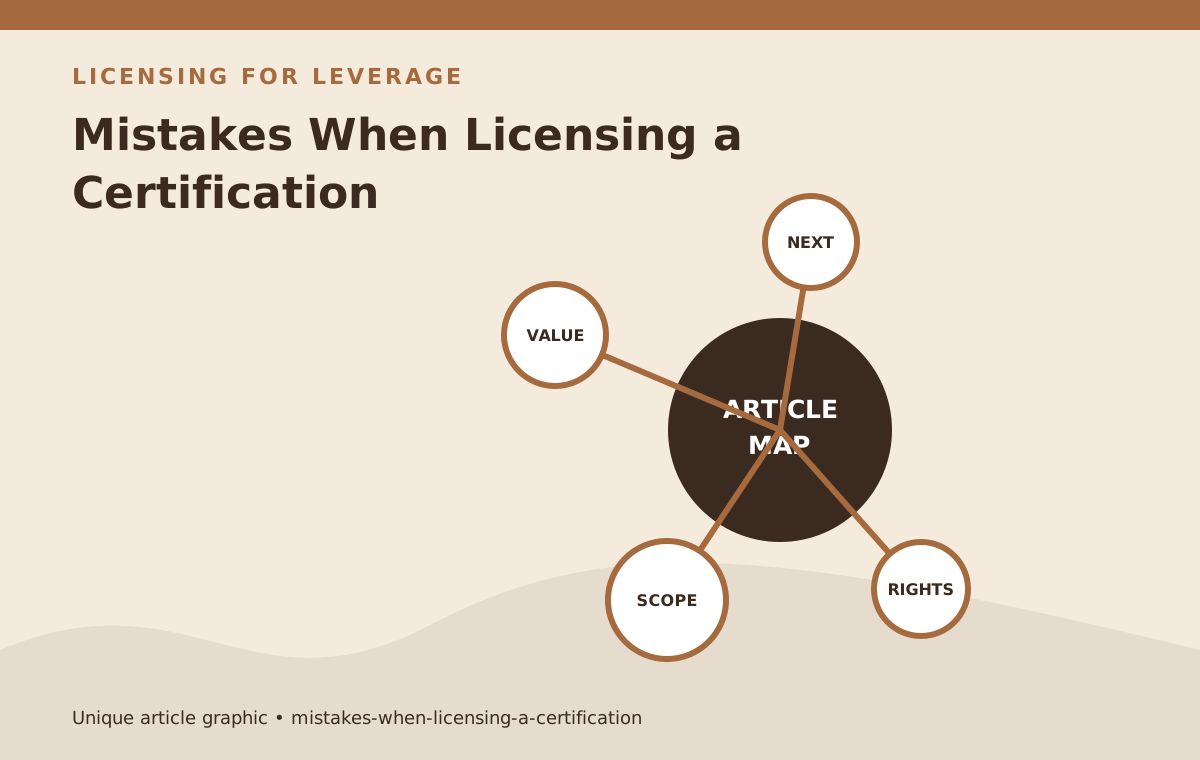
At a glance: The RIGHTS decision map
Use this sequence early:
- Resource: What asset, method, brand, content, software, or know-how exists?
- Intended use: What exactly may the licensee do, for whom, where, and through which channel?
- Guardrails: What remains prohibited, reserved, confidential, or subject to approval?
- Health of the model: How do both parties earn enough to perform their obligations?
- Tracking: What usage, quality, payment, and compliance records are required?
- Stop or renew: What triggers correction, suspension, termination, or renewal?
For this topic, the working version is: Failure mode Early signal Contract control Operating control Escalation. A useful licensing plan can explain that chain in one page before it expands into a detailed agreement.
What you need first
List the five failures that would most damage learner outcomes or brand trust, then connect each to a measurable control and an owner. Gather source files, proof of ownership or permission, current brand use, customer results that can be substantiated, delivery procedures, known exceptions, and the costs required to support another operator.
Create an “unknowns” list. Ownership, authority to sublicense, regulated activity, territory, tax characterization, and quality-control obligations are blocking unknowns. Preference questions such as portal color or optional meeting cadence usually are not.
Do not rely on the workbook keyword or a marketing phrase as legal classification. The USPTO’s IP basics distinguishes patents, trademarks, copyrights, and trade secrets, while the U.S. Copyright Office explains the exclusive rights a copyright owner can authorize.
Step 1: Define the licensable asset
Write an asset inventory with four columns: component, owner, evidence, and dependency. A component may be a name, manual, curriculum, rubric, database, design, software module, workflow, or confidential operating method. “My experience” is too broad. The licensee must know what it receives, and the owner must know what is excluded.
Record third-party dependencies. Stock media, guest content, software libraries, assessment items, customer data, and contractor work may carry restrictions. Ownership questions should be reviewed by qualified counsel before a commercial license is offered.
Step 2: Define the rights and boundaries
Describe the permitted action using verbs: reproduce, deliver, display, modify, distribute, certify, resell, sublicense, or use a mark. Then add audience, territory, channel, term, exclusivity, and volume. A statement such as “license our program” is not operationally precise.
Also define reserved rights. Can the owner sell directly in the territory? Can the licensee translate materials? Who owns improvements? May subcontractors deliver? What happens to learner or customer records at termination? These questions shape the model before a lawyer drafts the agreement.
Step 3: Model the economics
List every payment trigger separately: upfront license fee, recurring platform or support fee, per-user royalty, revenue share, minimum guarantee, renewal fee, training fee, or audit cost. For each trigger, define the measurement source, reporting frequency, payment timing, refund or credit handling, currency, tax documentation, and audit trail.
If assessors drift from the rubric, the early signal may be score variance, the control may be calibration, and the escalation may suspend new cohorts. This is an illustration, not a reported result or recommendation. The right model depends on the asset, market, bargaining power, service burden, and legal constraints.
Build three scenarios—conservative, base, and capacity-constrained. Include owner labor for onboarding, support, updates, sales enablement, quality review, dispute handling, and enforcement. Revenue is not passive merely because the invoice calls it a royalty.
Step 4: Design transfer and quality control
The transfer package should help a qualified licensee reproduce the intended result without improvising the protected core. It may include onboarding, operating procedures, trainer or operator standards, approved claims, brand rules, reporting templates, and escalation paths.
Choose evidence that matches the promise. Completion counts do not prove competence; sales volume does not prove brand compliance. Define leading indicators, outcome indicators, sampling frequency, and who may see the underlying records. Trademark licensing in particular requires legal advice about appropriate quality control.
Step 5: Run a bounded pilot
A pilot should answer named uncertainties. Limit the term, territory or cohort, rights, volume, and support commitment. Establish baseline facts, success measures, stop rules, review dates, and data ownership before launch.
The pilot is not permission to use a weak agreement. It is a smaller operating scope in which both parties can test transferability and economics. Log every exception. Repeated exceptions reveal a missing standard, a poor licensee fit, or an asset that is not yet transferable.
Comparison and review table
| Decision | Evidence to collect | Warning sign | Owner |
|---|---|---|---|
| Asset and ownership | Source files, assignments, registrations, dependency list | Rights assumed but undocumented | IP counsel/owner |
| Permitted use | Use case, channel, territory, audience, term | “Use our system” without boundaries | Business owner/counsel |
| Economics | Payment triggers, cost-to-serve, scenario model | Revenue forecast ignores support | Finance/operations |
| Quality | Standard, metric, sample, escalation | Brand promise has no audit path | Program owner |
| Reporting | Source system, cadence, reconciliation | Royalty calculated from unauditable data | Finance/licensee |
| Exit | Cure, suspension, termination, data return | No practical offboarding process | Counsel/operations |
Use the table as a readiness review, not as contract language.
Legal, tax, and evidence boundaries
- USPTO licensing guidance provides a current official starting point for why, when, and how IP licensing begins.
- U.S. Copyright Office Circular 16A explains permission and licensing for copyrighted works.
Educational disclaimer: This article provides general business education, not legal, tax, accounting, investment, franchise, or regulatory advice. Licensing arrangements can implicate intellectual-property ownership, trademark quality control, securities, franchise, employment, privacy, export, antitrust, tax, and industry-specific rules. Engage qualified advisers for the facts and jurisdictions involved.
No revenue, tax, legal, or “passive income” outcome is promised. Examples are illustrative and do not claim first-hand results, client results, ownership, testing, or a particular market rate.
A practical implementation path
During the first week, complete the asset inventory and the RIGHTS map. In week two, interview two potential licensees about transfer, economics, and support rather than pitching a finished offer. In week three, revise the operating package and scenario model. Only then prepare a counsel brief with the unresolved rights, compliance, tax, and contract questions.
If the asset cannot be described, transferred, measured, and governed, improve the operating system before selling broader rights. The Licensing for Leverage articles can help you work through related decisions. When the one-page model is coherent, use the LicenseOS planning tool or discuss the situation in a licensing consultation.
Related situations
- Read What Is Intellectual Property Licensing? when the rights model is still unclear.
- Review What Is Licensing Revenue? when the payment model needs clarification.
- Browse the Licensing for Leverage articles before sending a business brief to counsel.
FAQ
Does licensing automatically create passive income?
No. Licensing can shift delivery work to a licensee, but the owner may still perform sales, onboarding, support, updates, quality control, reporting review, and enforcement. Model those obligations explicitly.
Do I need a registered copyright, trademark, or patent first?
It depends on the asset and strategy. Copyright can exist automatically when qualifying original work is fixed, while registration and other IP protections can affect enforcement and transaction readiness. Obtain legal advice for the specific rights.
Is a template licensing agreement enough?
A template can expose issues, but it cannot determine ownership, permitted use, economics, quality controls, tax facts, or regulated obligations for a particular deal. Build the business brief first and have qualified counsel adapt the agreement.
How should a royalty be calculated?
Define the base, exclusions, source records, timing, currency, refunds, related-party transactions, audit rights, and examples. A percentage without a precise base is not an operational payment rule.
What should a pilot prove?
It should test transferability, licensee fit, support load, unit economics, reporting accuracy, and quality controls within a bounded scope. Decide success and stop criteria before launch.
Turn the idea into a business plan.
LicenseOS guides you from asset discovery through pilot planning and builds your decisions into a living licensing business plan.
Start building your planThis article provides general educational information and is not legal, tax, or financial advice. Licensing and franchise laws vary by jurisdiction and structure. Consult qualified professional advisors before offering or entering a licensing arrangement.