For the expert or business owner considering licensing
Licensing sounds passive when it is described from the outside. From the inside, it is a promise that another business can use your work, deliver it well, report honestly, and still make the economics work.
The subject gets easier when you stop treating it as one big answer and break it into a few decisions you can actually make.
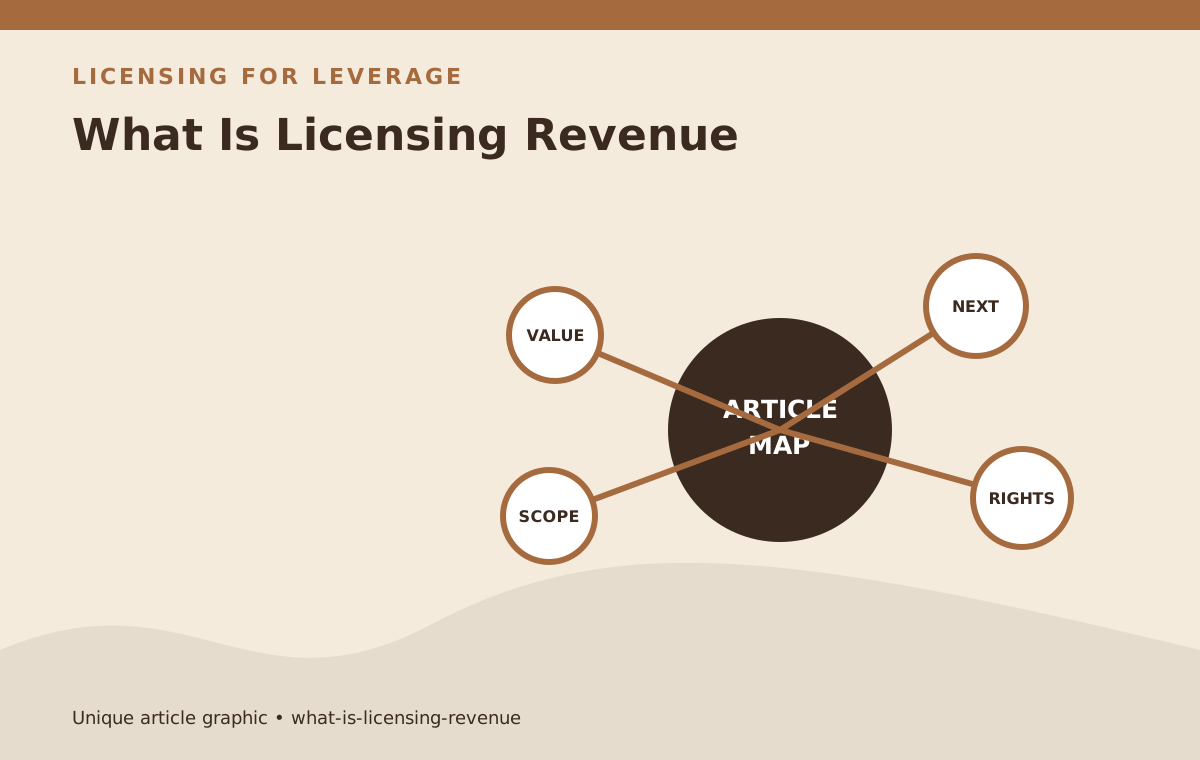
At a glance: Asset Rights Licensee Quality Revenue
| Look at | Ask yourself |
|---|---|
| The starting point | What is true right now—not what do I hope is true? |
| The desired result | What would “working” look like in ordinary use? |
| The hard limits | What safety, fit, access, legal, budget, or quality issue cannot be averaged away? |
| The next move | What is the smallest useful step that keeps options open? |
| The review | What will tell me to continue, adjust, or stop? |
That is the short version of this guide. Keep it visible while you read. It is easy to get pulled toward a feature, claim, or clever tactic and forget the decision you came to make.
Begin with the situation you actually have
People searching for what Is Licensing Revenue are often trying to solve two problems at once. There is the visible question in the title, and there is the quieter question underneath it: “How do I make a good choice without creating a new problem?”
Start by writing one sentence about the real situation. Name the person, the setting, the task, and the result. If the sentence could describe almost anyone, it is still too broad.
Then name the difficult version of the situation. What happens on a busy day, in poor conditions, with a new user, after repeated use, or when the first plan fails? The difficult version is where vague advice usually breaks.
What you need before you begin
You do not need a perfect plan. You do need a few facts:
- A specific asset you own or have permission to license.
- A repeatable result rather than a collection of ideas.
- A picture of the right licensee.
- A way to protect quality.
- Legal and tax questions for qualified advisers.
If one of those facts is unknown, call it unknown. Do not quietly replace it with a guess. Some unknowns can be tested. Others—especially those involving safety, medical fit, ownership, permits, taxes, or legal rights—need an authoritative source or a qualified professional.
Work from the outside in
Begin with constraints before preferences. A preference can be scored: faster, lighter, simpler, cheaper, more flexible. A constraint is different. If an option is unsafe, inaccessible, incompatible, prohibited, or impossible to support, a high score somewhere else does not rescue it.
Once the non-starters are gone, compare no more than three realistic paths. For each one, write down the upside, the drawback, the work it creates later, and the fact you are least certain about. That last column is often more useful than a long list of features.
Here is a simple way to see it:
| Path | What it solves | What it asks from you | What to verify |
|---|---|---|---|
| Keep the current approach | Avoids immediate disruption | Accepts the current limitation | Whether the problem is actually urgent |
| Make a small change | Tests one assumption | Requires observation and a stop rule | Whether the test matches real use |
| Change the system | Addresses the root constraint | Adds cost, setup, and learning | Whether the new system can be supported |
The middle path is often overlooked. A small, well-defined test can answer more than another hour of general research.
Try one small, honest test
Decide what you want to learn before you start. Then make the test small enough that you can stop without creating damage or a complicated cleanup.
Use normal conditions, not a best-case demonstration. Record what happened while it is fresh. Pay attention to the awkward moments: extra setup, confusing instructions, discomfort, inconsistent results, hidden costs, or work that shifts to someone else.
Most important, decide the stop point in advance. “I will know when it feels wrong” is not a useful rule. Name the condition that means pause, get help, or choose another path.
What tends to go wrong
The first mistake is chasing an answer before defining the problem. The second is treating a popular choice as evidence that it fits this situation. The third is noticing only the benefit and overlooking the support, maintenance, supervision, reporting, or follow-through it requires.
Another common mistake is collecting advice from sources that are talking about different versions of the problem. Check the date, model, jurisdiction, environment, and intended user. Two sources can both be reasonable and still apply to different situations.
Finally, do not turn a temporary workaround into a permanent system by forgetting to review it. Put the review on the calendar when you begin.
A useful reference point
Start with USPTO licensing guidance, U.S. Copyright Office guidance, and IRS royalty reporting instructions. Official guidance is a starting point, not a substitute for current product instructions, local rules, or advice based on an individual situation.
Educational disclaimer: this is general business education, not legal, tax, accounting, franchise, investment, or regulatory advice. Licensing also requires appropriate quality control. Get advice for the agreement, activity, entity, and jurisdictions involved.
The next 20 minutes
Take a blank page and write the five words from the map: Asset Rights Licensee Quality Revenue.
Under each word, add one fact and one unknown. Circle the unknown that could change the decision most. Your next action is to resolve that unknown—not to read ten more general articles.
When the important facts are clear, choose one small test. Write down the stop rule and the review date. That is enough to move forward without pretending you know more than you do.
Other situations that may be connected
- If the choice is still too broad, look for a comparison guide that uses the same setting and user.
- If an existing approach is failing, troubleshoot the earliest point where the result changes.
- If the decision affects health, safety, access, ownership, coverage, tax, or legal rights, prepare questions for a qualified professional.
Continue through the Licensing for Leverage articles or use LicenseOS to organize the next decision.
Questions people usually ask
Is there one best answer?
Usually not. There is a best fit for a particular person, task, setting, and set of constraints. Change those facts and the answer may change too.
How much research is enough?
Enough to eliminate unsafe or unsuitable options and identify the most important uncertainty. After that, a small realistic test is often more informative than more general reading.
What should I write down?
Keep the situation, sources, date, options considered, stop rule, and what happened. Good notes make later decisions faster and help another person understand your reasoning.
When should I ask for professional help?
Ask when the consequence of a mistake is high, the rules depend on individual facts, or the available sources conflict. Bring your notes so the conversation can start with the real situation.
Make the next decision easier
The goal is not to become an expert in every part of what Is Licensing Revenue. It is to make one sound decision, learn from it, and leave a clear trail for the next one.
Turn the idea into a business plan.
LicenseOS guides you from asset discovery through pilot planning and builds your decisions into a living licensing business plan.
Start building your planThis article provides general educational information and is not legal, tax, or financial advice. Licensing and franchise laws vary by jurisdiction and structure. Consult qualified professional advisors before offering or entering a licensing arrangement.