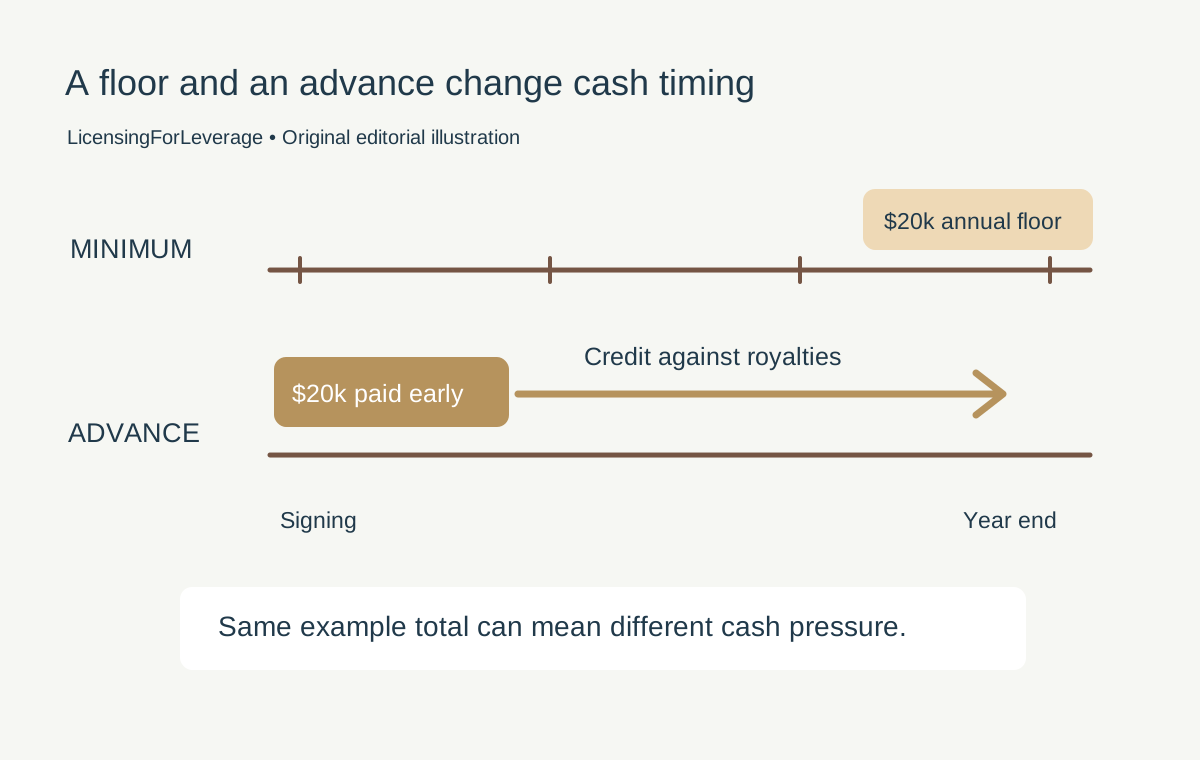
A minimum guarantee establishes a payment floor under the agreement; an advance changes when money is paid and may be credited against specified future royalties. The terms can overlap in a contract, so compare the actual crediting, timing, refund, and termination provisions rather than choosing a deal by its label. Build a period-by-period cash model before negotiating a headline amount.
At a glance: read the economics together
- Define the royalty base and rate. Identify what sales, deductions, territories, products, and reporting periods count.
- Separate payment timing from the economic floor. An upfront payment and an annual minimum answer different questions.
- Specify exactly how credits work. Check which royalties can recoup the advance and whether unused credit expires.
- Model downside, expected, and stronger sales cases. Calculate cash paid as well as earned royalties.
- Connect the numbers to performance and exit terms. Review shortfalls, refunds, termination, exclusivity, and support obligations.
- Have legal and tax advisers review the complete proposal. A spreadsheet cannot establish enforceability or tax treatment.
Start with the royalty formula
Write the royalty formula in plain language before entering a minimum or advance. Identify the covered products or services, territory, channels, reporting period, rate, and permitted deductions. A percentage is not meaningful until the underlying base is clear. Two offers with the same rate can produce very different payments if one permits broad deductions or excludes a major channel.
Use transaction examples to test the definition. Ask how returns, discounts, bundled products, affiliate transactions, currency conversion, taxes, and delayed collections are handled where relevant. Do not assume every agreement uses net sales in the same way. Have counsel draft or review the definitions and ask the finance team whether the required data can actually be produced.
Keep the model's assumptions beside the formula. If the base is still being negotiated, show alternative calculations rather than hiding a preferred interpretation in a spreadsheet cell. That makes the commercial disagreement visible before either party treats the numbers as settled.
Distinguish a floor from an early payment
For modeling purposes, a minimum guarantee can be represented as a contractual payment floor for a specified period, subject to the agreement's actual terms. If earned royalties are below the floor, a shortfall may become payable. The timing of that payment, any exceptions, and the consequences of nonpayment need explicit language.
An advance is an earlier payment. It may be creditable against future royalties, nonrefundable, limited to particular categories, or subject to other negotiated conditions. An amount called an advance does not tell you all of those things. Read the clauses describing recoupment, refundability, reporting, and expiration.
WIPO's historical Licensing Guide discusses advance payments and minimum royalty arrangements as licensing structures. Use it for conceptual background, not as current jurisdiction-specific legal advice. The practical definitions in your deal must come from the reviewed agreement.
Work through one illustrative comparison
Assume, solely for illustration, a 5% royalty on a clearly defined sales base. Compare two independent one-year proposals. Proposal A has a $20,000 annual minimum, with earned royalties credited toward that floor. Proposal B has a $20,000 nonrefundable advance, fully creditable against that year's royalties, with no separate additional minimum. Assume no tax, currency, timing, default, or other adjustments for this simplified comparison.
At $200,000 of royalty-bearing sales, earned royalties are $10,000. Under the stated assumptions, both proposals produce $20,000 of total payment for the year, although Proposal B requires its advance earlier. At $600,000 of sales, earned royalties are $30,000; Proposal B would have $10,000 payable beyond the advance, while Proposal A reaches $30,000 total through its reporting and payment schedule.
Those similar totals do not make the proposals interchangeable. The timing of cash, treatment of termination, permitted credits, and availability of funds can differ substantially. Change one assumption and the result may change. The example is not a recommended rate, a market benchmark, or an expected revenue outcome.
Compare scenarios in a real table
| Assumed sales base | Earned royalty at 5% | Proposal A annual total | Proposal B annual total | Key difference still unresolved |
|---|---|---|---|---|
| $0 | $0 | $20,000 | $20,000 | When cash is due and what termination changes |
| $200,000 | $10,000 | $20,000 | $20,000 | Upfront cash burden and credit tracking |
| $400,000 | $20,000 | $20,000 | $20,000 | Reporting schedule and reconciliation |
| $600,000 | $30,000 | $30,000 | $30,000 | Timing of the additional $10,000 |
The table assumes each proposal operates exactly as described above. It deliberately does not combine an advance with a separate minimum. If your agreement contains both, specify whether and how the advance counts toward the minimum; never simply add or subtract them based on their names.
Build the cash calendar separately
Create a row for signing, launch, each reporting period, annual reconciliation, and any renewal payment. Show opening credit, earned royalties, credit applied, additional cash due, and closing credit. Separate cash received by the licensor from revenue recognition and taxes, which require accounting advice.
For the licensee, add manufacturing, marketing, distribution, staffing, and working-capital needs. A payment can be affordable in an annual profit model and still create a cash shortage before launch. For the licensor, include training, approvals, technical support, quality oversight, and reporting review. An upfront receipt is not free capacity.
Run a delayed-launch case as well as a low-sales case. If the licensee cannot begin selling for several months, determine whether the minimum period still starts at signing and whether any relief is available. Avoid assuming that a commercially disappointing launch automatically excuses a contractual obligation.
Read the credit and exit provisions closely
Ask whether the advance can be credited across different products, territories, years, or agreements. Cross-crediting can shift the economics: strong sales in one area might consume a credit intended for another. A yearly minimum may also behave differently from a total minimum over the full term.
Identify what happens to unrecouped amounts when the license ends. Is any amount refundable, and under which circumstances? Does a sell-off period generate royalties that can still use the credit? What reports and payments survive termination? These are drafting questions for counsel, not blanks to fill using a spreadsheet default.
Connect minimums to exclusivity and performance obligations. A licensor may care about market development as well as cash; a licensee may need enough time and support to launch responsibly. Paying a minimum does not necessarily satisfy separate quality, reporting, distribution, or launch requirements. Read those obligations together.
Keep rights and quality control in the negotiation
A payment structure cannot repair uncertain ownership or an unclear grant of rights. Confirm what intellectual property is licensed, who owns it, and which uses are excluded. WIPO's assignment and licensing overview distinguishes licensing from transferring ownership and discusses the importance of control in trademark licensing.
Where trademarks are involved, plan meaningful quality control with counsel: standards, approvals, monitoring, correction, and records. Include the operational cost of that work. A deal that promises passive income while ignoring approval and oversight responsibilities is missing important business assumptions.
Also evaluate whether the arrangement raises franchise or other regulatory questions. The FTC Franchise Rule compliance guide is a starting point for U.S. franchise analysis, but the answer depends on the facts and applicable law. Renaming a payment or agreement does not settle its legal classification.
FAQ
Is an advance always refundable if sales disappoint?
No. Refundability depends on the agreement and applicable law. Model the actual clause and ask counsel about its effect before relying on a refund as downside protection.
Does a minimum guarantee promise profit to the licensee?
No. It is a payment obligation under specified terms, not an assurance that sales or margins will cover it. Model costs, launch timing, and downside demand independently.
Can the same agreement contain both terms?
Yes. The essential question is how they interact. Ask which payments count toward which obligations, when credits apply, and whether unused amounts carry forward.
Your next action and professional limits
Take one proposed term sheet and create two separate worksheets: royalty economics and cash timing. Enter a zero-sales case, a delayed launch, and a stronger-sales case. Mark every unresolved definition for legal or accounting review before negotiating the amount.
Educational disclaimer: this is general business information, not legal, tax, accounting, franchise, investment, or valuation advice. No royalty, minimum, advance, passive-income, or earnings result is guaranteed. Use qualified legal and tax advisers, and review IRS royalty-income information with your tax professional where relevant. Continue with the licensing revenue explainer and article library.
Turn the idea into a business plan.
LicenseOS guides you from asset discovery through pilot planning and builds your decisions into a living licensing business plan.
Start building your planThis article provides general educational information and is not legal, tax, or financial advice. Licensing and franchise laws vary by jurisdiction and structure. Consult qualified professional advisors before offering or entering a licensing arrangement.